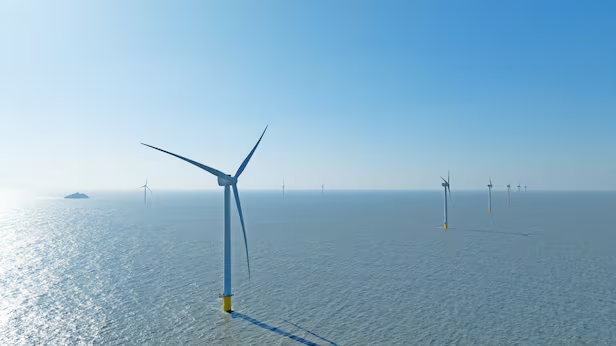
South Korea has reached a pivotal moment in its clean energy transition with the successful commissioning of Jeonnam 1, the nation’s largest privately-led offshore wind farm. This groundbreaking 96-megawatt project marks a significant step forward in Asia’s quest for sustainable energy independence and sets a powerful precedent for the region’s renewable energy sector.
- A Game-Changing Milestone for Korean Renewable Energy
- Public-Private Partnership Drives Success
- Technology and Innovation at the Core
- Local Economic Impact and Supply Chain Development
- South Korea’s Ambitious Offshore Wind Roadmap
- Strategic Importance for Regional Energy Security
- Regulatory Framework Evolution
- Global Context and Climate Leadership
- Challenges and Opportunities Ahead
- Looking Forward: A Template for Asia
- Conclusion: A Beacon for Renewable Energy’s Future
A Game-Changing Milestone for Korean Renewable Energy
Located approximately 9 kilometers northwest of Jaeundo in Shinan County, Jeonnam Province, the Jeonnam 1 offshore wind farm represents more than just another renewable energy project—it’s a blueprint for South Korea’s ambitious clean energy future. The facility, which completed turbine installation in December 2024, officially began commercial operations in early 2025, delivering on years of meticulous planning and execution.
The project’s impressive specifications tell a compelling story: 10 state-of-the-art wind turbines generating approximately 301 million kilowatt-hours of electricity annually. That’s enough clean power to supply roughly 90,000 Korean households for an entire year, while simultaneously preventing an estimated 125,600 to 240,000 tons of carbon dioxide emissions annually—equivalent to removing tens of thousands of vehicles from the roads.
Public-Private Partnership Drives Success
What makes Jeonnam 1 particularly noteworthy is its innovative financing and partnership model. The project emerged from a joint venture between Copenhagen Infrastructure Partners (CIP), through its Copenhagen Infrastructure III fund, and SK Innovation E&S, one of South Korea’s largest conglomerates. Copenhagen Offshore Partners (COP) served as the exclusive development partner, bringing world-class expertise in offshore wind project management.
This successful collaboration secured funding through Non-Recourse Project Financing, establishing a new benchmark for public-private partnerships in Asia’s renewable energy sector. The achievement demonstrates that large-scale offshore wind projects can be financially viable and attractive to private investors when structured properly.
Jonathan Spink, CEO of COP Korea, emphasized the project’s significance: “This project exemplifies how strong collaboration and innovative financing can unlock Korea’s offshore wind potential. We are proud to support the development of sustainable energy infrastructure that not only drives economic growth but also helps Korea meet its ambitious climate goals.”
Technology and Innovation at the Core
The Jeonnam 1 project utilized cutting-edge technology throughout its development and construction phases. Construction began in March 2023, with turbine installation commencing in September 2024. The rapid execution timeline—completing all installations by December 2024—showcases the efficiency of modern offshore wind construction methods and the expertise of the international teams involved.
The fixed-bottom wind farm operates in waters with depths ranging from 10 to 20 meters, making it an ideal testing ground for South Korea’s offshore wind capabilities. Since beginning commercial operations, the facility has consistently exceeded daily generation targets, producing an average of 913,000 kilowatt-hours per day.
Local Economic Impact and Supply Chain Development
Beyond its environmental benefits, Jeonnam 1 has catalyzed significant economic development in the region. The project prioritized partnerships with Korean suppliers and leveraged local ports and infrastructure, directly contributing to the growth of South Korea’s domestic offshore wind supply chain ecosystem.
The initiative has created numerous jobs and provided valuable training opportunities for Korean professionals in the offshore wind sector. This knowledge transfer and skills development will prove crucial as South Korea pursues even more ambitious renewable energy targets in the coming years.
Jesper Krarup Holst, COP Partner and Head of APAC, noted: “We remain committed to supporting the development of sustainable solutions that create local value, strengthen supply chains, and contribute to Korea’s energy independence and climate commitments.”
South Korea’s Ambitious Offshore Wind Roadmap
Jeonnam 1 is just the beginning of South Korea’s offshore wind journey. The country has set aggressive targets to establish itself as a major player in the Asian renewable energy market:
- By 2026: 7-8 gigawatts of offshore wind capacity through government-supported auctions
- By 2030: 14.3 gigawatts of offshore wind generating capacity
- By 2038: 40.7 gigawatts of total wind capacity (including onshore and offshore)
Building on the success of Jeonnam 1, SK Innovation E&S and CIP plan to develop Jeonnam 2 (399 MW) and Jeonnam 3 (399 MW), with completion targeted for 2031. Once fully operational, the three wind farms will boast a combined capacity of approximately 900 megawatts—comparable to a single nuclear power plant.
Strategic Importance for Regional Energy Security
South Korea’s push into offshore wind comes at a critical time for the nation’s energy security. The country currently relies heavily on imported fossil fuels, making energy independence a strategic priority. The successful deployment of Jeonnam 1 demonstrates that offshore wind can play a crucial role in diversifying the nation’s energy portfolio while supporting climate goals.
The project also aligns with South Korea’s broader commitment to phase out coal-fired power generation by 2040 and transition toward a renewable energy-dominated grid. As the world’s major economies compete to lead the clean energy transition, South Korea’s offshore wind sector positions the nation as a key player in Asia’s green energy future.
Regulatory Framework Evolution
The success of Jeonnam 1 has been supported by South Korea’s evolving regulatory framework for offshore wind development. In August 2024, the Ministry of Trade, Industry and Energy (MOTIE) unveiled a comprehensive roadmap to accelerate offshore wind deployment, introducing:
- A two-stage bid evaluation process for increased transparency
- Separate bidding systems for floating offshore wind farms
- Enhanced Renewable Portfolio Standard (RPS) requirements
- Quarterly tender schedules starting in 2025
- Government-led site selection to streamline permitting
These regulatory improvements, combined with proven project success like Jeonnam 1, are expected to attract significant additional investment into South Korea’s offshore wind sector.
Global Context and Climate Leadership
South Korea’s offshore wind achievements must be viewed within the broader context of global climate action. At COP28, countries worldwide committed to tripling renewable energy capacity by 2030. Projects like Jeonnam 1 demonstrate that this ambitious goal is achievable with proper planning, financing, and execution.
The International Energy Agency’s “Renewables 2024” report highlights South Korea as one of the countries making meaningful progress toward renewable energy targets, though much work remains to meet the global tripling commitment. Offshore wind will be crucial to closing the gap between current renewable capacity and 2030 targets.
Challenges and Opportunities Ahead
While Jeonnam 1 represents a major success, South Korea’s offshore wind sector still faces several challenges:
- Grid Integration: Expanding transmission infrastructure to handle increased renewable generation
- Supply Chain Competition: Competing with lower-cost Chinese turbine manufacturers
- Permitting Delays: Streamlining environmental impact assessments and stakeholder approvals
- Community Acceptance: Building local support for offshore wind development
- Financing Structures: Developing more innovative funding mechanisms for large-scale projects
However, these challenges also present opportunities for innovation, job creation, and technological advancement. As South Korea addresses these issues, it will develop expertise that can be exported to other emerging offshore wind markets across Asia.
Looking Forward: A Template for Asia
The Jeonnam 1 project offers valuable lessons for other Asian nations looking to develop their offshore wind sectors. Key success factors include:
- Strong public-private partnerships with clear risk allocation
- Integration of international expertise with local knowledge
- Commitment to supply chain development and job creation
- Transparent regulatory frameworks with predictable auction schedules
- Community engagement and benefit-sharing mechanisms
Countries like Vietnam, the Philippines, Japan, and Taiwan are closely watching South Korea’s progress, with many planning their own offshore wind development programs.
Conclusion: A Beacon for Renewable Energy’s Future
The successful commissioning of Jeonnam 1 offshore wind farm represents more than just megawatts added to South Korea’s grid—it symbolizes the nation’s commitment to clean energy leadership and climate action. By demonstrating that large-scale offshore wind projects can be financially viable, environmentally beneficial, and economically transformative, South Korea has provided a roadmap for sustainable energy development across Asia.
As the global community races to combat climate change and achieve net-zero emissions, projects like Jeonnam 1 prove that the transition to renewable energy is not only necessary but entirely achievable. The wind turbines spinning off Shinan County’s coast are generating more than electricity—they’re powering hope for a cleaner, more sustainable future.
With ambitious expansion plans already in motion and a proven track record of successful execution, South Korea’s offshore wind industry is poised for exponential growth. The question is no longer whether offshore wind can succeed in Asia, but how quickly the region can scale this proven technology to meet its enormous energy needs.
About RenewableTime: Stay updated with the latest developments in renewable energy from around the world. Follow us for daily news, in-depth analysis, and expert insights on solar, wind, hydrogen, and clean technology innovations shaping our sustainable future.
Keywords: offshore wind, South Korea renewable energy, Jeonnam 1 wind farm, Copenhagen Infrastructure Partners, SK Innovation E&S, clean energy transition, Asian offshore wind, renewable energy news, wind power generation, climate change solutions